OPINION
Reality, Realignment & Restoring Equilibrium
The recent Sinn Fein statement, urging the necessity for increased dialogue with Loyalism, may represent another important milestone within our peace-process; and yet it will be how it is received, heard and responded to in particular; that may indeed mark the beginning of the development of a new phase within that peace-process.
If we have learned anything; it is only through the process of dialogue, that new understandings can emerge, which can allow a space where our various issues/problems can be aired, explored and ultimately resolved.
Loyalism itself has done much of the share of the heavy-lifting within our peace-process, and has never run away from the challenges of peace-building.
Yet clearly there are still huge challenges that lay ahead…
Many would acknowledge that Mainstream-Republicanism has long been concerned with the residues of their former armed-campaign, which increasingly have begun to express themselves within a myriad of various dissident factions. Whilst there is no doubt that Republicanism has been quick off the mark to stand up both publically and privately to this threat against post-conflict society, that lurks within their particular midst; Yet at the same time, many would point out that they have often been less than generous with their assessment and accuracy of the level of threat actually posed by these groups, or indeed the impact on the Loyalist community.
Republicans would previously have applied terminology like ‘micro-groups’ to these factions, playing down the threat to wider society, and more importantly themselves, yet this indicates that they have now moved into a space where the assessment has dramatically changed, to one where these dissident groupings represent a ‘real and sustained threat’ to our emergent post-conflict society and the new political dispensation.
The reality of the dissident threat has remained all too real for the Loyalist community, with under-car bombs and mortar firing tubes discovered lately within predominately Loyalist areas, that not only placed a local civilian population at extreme and unacceptable risk, but which were also placed worryingly close to a Protestant primary school and highly populated residential areas on more than one occasion.
Indeed, it has been increasingly obvious for some time, particularly within Loyalist communities, that various chunks of the Republican movement have become sliced off the seemingly once solid Republican monolith, albeit without having yet gained the necessary community traction required to intensify or popularise that campaign. It is also clear that these dissident residues in our midst continue to cling to the umbilical cord of a militant ideology, with the haemorrhaging of members, expertise and munitions a feature of the transitionary process itself that Republicanism has undertaken. This is in itself a measure of how far Republicanism has come
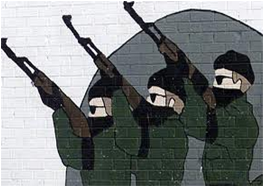
However, many would argue that any reconciliatory message invariably gets diluted by the high-resolution image of young kids dressed in paramilitary uniform, the presence of a masked man firing a volley of shots at a Republican commemoration, as well as the backdrop of bombings/shootings etc that have been a recurrent feature of the ‘forever war’ concept.
From a Loyalist perspective, the aggregated de-construction happening within the Republican Movement has occurred over a period of time, as that movement signed up to historic and important societal developments such as supporting Policing and ending their previous policy of abstentianism within the ROI jurisdiction etc, with various chunks of that movement being sliced off at each key juncture deemed a step too far.
It is clear these groups are now engaged in a battle for the hearts and minds of Republicanism itself, and this is something that has kept Sinn Fein increasingly focussed on looking over their own shoulder and thus engaged in playing to that parochial audience, with the intention of placing a sticking plaster over what is becoming an increasingly fractured form of Republicanism.
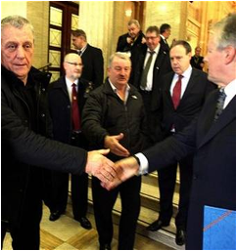
Of course, calls for a’ border-poll’ and ‘national-reconciliation’ are just that, playing to their parochial audience, intended to repair that fractured edifice and keep it intact, designed to convince the dissidents behind their shoulder of its achievability, place militant campaigns aside and reconnect the strands of Republicanism into a solidified form. There is a concern that this is in danger of turning the peace-process into an ‘appeasement-process’! Yet in doing so, they must realise that for every action there is also a reaction, and their actions will contribute to the reactionary growth of dissidence in the Loyalist community as a by-product of any appeasement-process. Indeed, many would now reflect, that in looking exclusively over their own shoulder, that we have failed to look over each other’s shoulders, and that we now require a renewed urgency to move beyond parochial approaches to what are increasingly becoming collective and complex problems.
However, within any wider problem solving framework, parochial approaches should still have an important role and function, such as the Unionist Forum, or indeed Sinn Fein’s offer to talk to Republican dissident groupings (which itself can be interpreted as the initial seeding of a Republican Forum). Indeed, holistic problem solving requires both an inward looking focus as well as an external and systemic one.
There are many that would point out that the scales of our peace-process have become imbalanced lately, and precariously over-laden, having since lost their important equilibrium, which has seen those scales begin to buckle and even crack under the applied pressure. Indeed, within this context, it is now becoming increasingly obvious that dissident voices, and actions, have now appeared over the Loyalist shoulder, which itself has begun to re-animate conflict-mindsets within our own community, which have invariably begun to play out on our streets. That the recent violence has failed to migrate across the Province, is itself evidence of how far Loyalist communities and their associated leaderships have come in holding that line. However, it must be said that Loyalism itself has not remained immune or insulated from the fracturing-edifice effect. Yet it is important to reflect that this has often happened at a much slower pace and to a lesser degree, in comparison to the Republican example, and hasn’t of yet, formed itself into or expressed itself as, an entity that constitutes a serious and sustained threat to society or the peace-process. Yet we cannot be complacent or take that for granted either. The existence of expressions of dissidence and a clear undercurrent of anti-peace process sentiment, as well as the physical force out-workings of this, threaten to pull us all back into the abyss of our past.
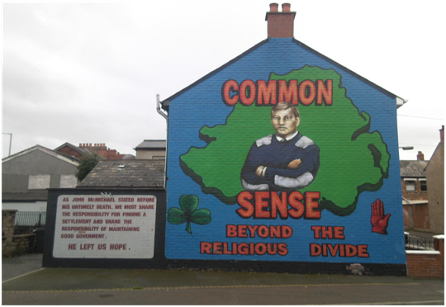
We cannot afford to underestimate or ignore the extent of the problems and challenges ahead of us as a society, which has raised genuine concerns around the actual unravelling of the peace-process itself, and the divergence from what were, and still are, hard won dispensations.
Whilst we would agree that much progress has been made within the peace-process, the political-process itself remains locked in abject failure regards addressing the social-injustice experienced, which is felt more acutely within those working-class communities that found themselves at the coal-face of that conflict and who still endure the harsh socio-economic realities, and many would reflect that the political process is not working as intended or designed.
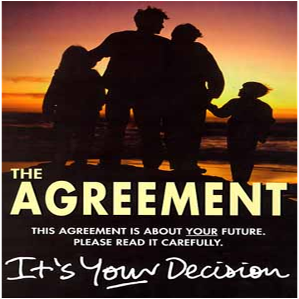
Indeed, the Agreement raised community expectations, linking the onset of peace with increased prosperity.
In many ways, the imagery that sold the Agreement and which won people’s vote, in particular that of a family backlit by the dawn of a new tomorrow, promised much. If people had to vote now for that Agreement, in hindsight, many believe a resounding NO would be the likely outcome.
Whilst we undoubtfully live in an infinitely better place than the one we left behind, the lives of those working-class communities that bore the brunt of conflict, have not really changed that much. That itself is part of the un-finished business of our peace-process. Indeed, other undelivered aspects of the Agreement, around a proposed Bill of Rights in particular, may have created a framework for securing the inclusivity of social, cultural and economic rights across society. Likewise the Civic Forum may have been a useful mechanism to begin to hold our politicians accountable for delivery on their commitments, and in effect cushion the peace-process within the civic-sphere. Yet they both represent parts of the socio-political architecture that have been left neglected and discarded. Indeed, the introduction of a rights-based approach, as insurance for ‘inclusivity’, is itself an issue which Loyalists have been advocating for numerous years, and thus is not a concept exclusive to the Republican community.
A bill of rights was first proposed in 1975 by the Ulster Civil Liberties Centre based at 275a Shankill Rd, within a document entitled ‘a proposed bill of rights for the United Kingdom’. Whilst it is perhaps unfair to highlight any one particular incident, within what is a significant and extremely emotive back-catalogue, nevertheless it may be necessary to allow us to grasp the enormity of the challenges ahead, without intending to elevate any incident above another or give an apportionment of blame. One of the main architects of the proposed Bill of Rights, Sammy Smith (UPRG) was killed the following year at Alliance Ave in North Belfast by the IRA.
Despite Sinn Fein’s current insistence that they wish to ‘uphold the rights of all’, many within our community would still interpret this as a deliberate attempt to quash the emergence of a rights-based approach within the Loyalist community. Likewise other events would still be interpreted as attempts to kill off the development of a Loyalist political project intended to benefit all. Make no mistake, there is still a lot more ‘convincing’ required (on all sides) as well as yet uncharted depths of feelings and interpretations to navigate, and we must not underestimate this psychological journey either. Behind the mere words of ‘convincing’, clearly there is much more spadework required!
No doubt there are many challenges ahead that face us all, yet with any challenge there are also opportunities. We need to restore an equilibrium to the new society we are committed to and engaged in building, and which we have consequentially mandated into the hands of our political representatives.
The core failure and inherent fault-line in terms of politics; is expressed as a basic lack of understanding around how the big-picture invariably plays out locally within Northern Ireland politics. In effect there are two distinct processes, a political process & a peace-process, and the two have become somewhat untangled recently with their linkage weakened. In moving forward and building this future, it is imperative that we begin to understand how our macro-level political decisions impact on the grassroots based peace-process itself. In this context, we particularly welcome how the emphasis has been placed on the centrality of the local, in terms of community processes, as the essential cement for building that new society on a solid foundation, within what must be a ‘bottom-up development’. Indeed, we begin to see an acknowledgement from Republicanism, though still somewhat reticent, as to how that big picture plays out locally, in the references made around the concerns relating to the erosion of culture and identity that exists within the Protestant/Unionist/Loyalist section of our community in particular, concerns that themselves emerged due to macro-level political decisions not taking account of local impact. Indeed, such decisions have undoubtedly impacted on the local processes that they now profess to value. This itself, would lead many to the assumption that at the macro-political level, politics itself is no longer earthed to the peace-process. However, this statement does present an opportunity to explore how we deal with the residues of conflict that have become lodged within both our respective communities.
The existence and growth-rate of these residues particularly highlights the need to move away from a framing where that Agreement is presented as some sort of ‘irreversible done-deal’, to one that requires a lot more consideration, care and effort to get it right, lest it unravels. It may also open a useful space to begin to focus on addressing the socio-economic deficits that exist and particularly how these are experienced within the restless undergrowth of our new society.
To continue to play the parochial politik in this, will only serve to consolidate, strengthen and polarise society further down strict Republican/Unionist lines, rather than realigning it down pro-peace/anti-peace ones that cross those traditional boundaries. We must begin to re-earth that peace-process through realigning the positive currents. In this regard, it is important to stress that there is still an inherent responsibility on both the British & Irish Governments, as guarantors and persuaders, to become a part of this positive realignment, with many advocating the position that they have ‘left the stage too early’. This itself opens up the debate to the need for an International-reconciliation process. Indeed, such a process, would be more aligned to the 3 stranded approach contained within the GFA, that accounts for the complexity of the three set of relationships that defined our Agreement; internal, North/South and East/West.
The challenge will be to align the pro peace-process diaspora across all our communities. Now is the time for a more co-ordinated and joined-up approach. It is imperative for us all to become advocates within this. To defend the peace, and secure the future for our next generation.

This opinion piece was developed by the North Belfast Branch of the UPRG.
It has been submitted on behalf of the North Belfast Branch by John Howcroft, a former life-sentence loyalist prisoner and community activist.